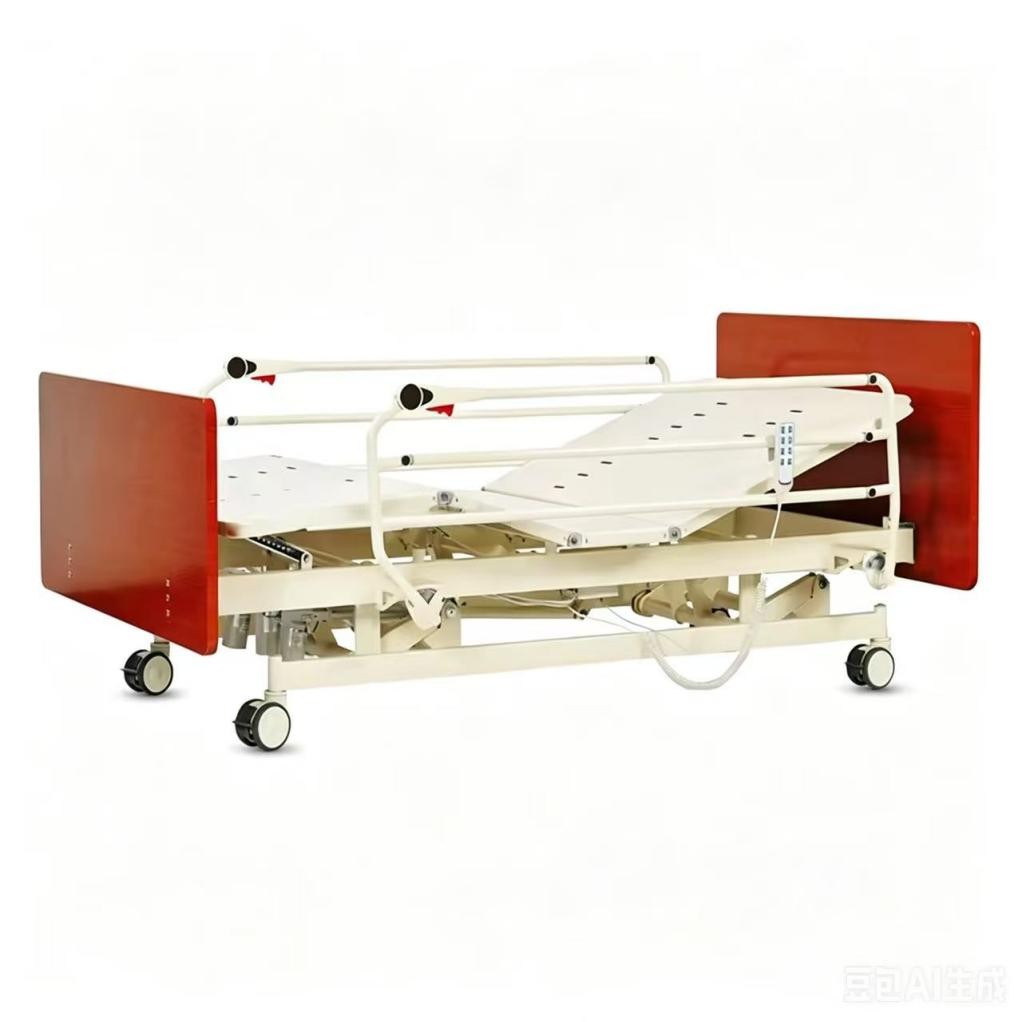
A well-configured hospital ward bay is not simply a bed in a room — it is a coordinated patient environment. Here is how a thoughtfully assembled 3-function electric bed set delivers clinical function, patient comfort, and everyday practicality in equal measure.
When a patient is admitted to a general hospital ward, the immediate environment around them matters more than most facility managers account for. A bed that moves imprecisely, a side table that cannot reach, or a surface too hard to rest on overnight — each of these erodes recovery, strains nursing workflows, and reflects poorly on the standard of care. The modern ward configuration described here assembles five carefully matched items into one complete, functional patient bay: a 3-function electric bed, foam and air mattress options, a bedside cabinet, and an overbed table. Together, they represent the considered baseline that every standard ward should be equipped to offer.
The 3-Function Electric Patient Bed — The Foundation of the Bay
At the centre of the ward configuration sits the 3-function electric patient care bed — a bed built specifically for general inpatient use, where reliable adjustability is needed without the complexity of a full ICU model. The three core electric adjustments are head elevation (up to 65°), knee and thigh articulation (up to 35°), and full height adjustment from approximately 350 mm at its lowest to 700 mm at its highest. These three movements, individually or in combination, cover the vast majority of therapeutic and nursing positioning needs encountered on a general ward.
The head elevation allows patients to sit up for meals, breathing support, or simple comfort without nursing assistance. The knee raise, critically, is linked to the head raise — as the backrest rises, the thigh section lifts automatically to at least 15°, preventing the patient from sliding toward the foot of the bed. This integrated anti-slide mechanism is not a luxury; on a busy ward where a patient may adjust their own position unassisted, it is a fundamental safety feature. The height adjustment, meanwhile, allows the bed to be lowered for patient entry and exit and raised to an ergonomic working height for nurses during care tasks, significantly reducing manual handling risk for staff.
“Three precise electric adjustments — head, knee, and height — are enough to address nearly every positioning need on a general ward, without overcomplicating the patient experience.”
The bed frame is constructed from heavy-duty carbon steel with an electrostatic epoxy powder coat finish, available in a matched colour range. The sleep surface measures 2,000 mm × 1,100 mm — accommodating a wide patient population — and the frame overall sits at 2,050 mm × 1,150 mm, sized for standard ward bay layouts. Lockable castors with a diameter of approximately 120 mm allow the bed to be repositioned or transported easily, and the lower frame maintains at least 120 mm of ground clearance, which is sufficient for a hoist to pass underneath — a practical requirement that is too often overlooked at procurement stage.
Two features of the physical construction deserve particular mention. The headboard and footboard are solid wood panels, and both are fully detachable. This allows clinical staff to remove a board rapidly during resuscitation or when radiographic equipment needs direct access to the patient from the head end — no tools, no delay. The second feature is the guardrails: 3/4-length foldable and lockable side rails on both sides of the bed. They cover enough of the bed’s length to prevent a patient from rolling out during sleep, yet fold away smoothly for care access, assisted transfers, and patient egress without obstructing the entire bedside. A wired patient handset gives the individual direct control of all positioning functions, and a rechargeable battery backup ensures the bed remains fully operable during power interruptions or when moved between departments.
Mattress Options — Standard Foam and Alternating Air
OPTION A
Standard Foam Mattress
The standard foam mattress uses a high-density polyurethane core at 28 kg/m³, sized at 1,100 mm × 2,000 mm × 120 mm minimum, with a load rating of 180 kg or greater. Its cover is waterproof, zip-removable, and made from fire-retardant, anti-bacterial, anti-mite quilted cotton fabric — meeting both infection control and fire safety requirements. For patients at low-to-moderate pressure ulcer risk, this mattress provides a soft, supportive sleep surface that is easy for ward staff to clean and change.
OPTION B
Alternating Pressure Air Mattress & Pump
For patients at elevated risk of pressure injury — those who are immobile, post-operative, or have compromised skin integrity — the alternating pressure air mattress replaces the foam option on the same bed frame. Its tube-type cell structure inflates and deflates in a programmed alternating cycle, continuously redistributing body weight across the support surface and preventing sustained pressure on any single anatomical point. This mechanism is clinically recognised for prevention of Stage I and Stage II pressure ulcers. Pressure is adjustable via a control knob to match patient comfort and clinical need. The compact, quiet pump makes it suitable for ward environments where noise management is important, and the non-toxic waterproof cover ensures the same infection control standards as the foam option. Crucially, both the mattress and pump originate from the same manufacturer as the bed, ensuring a consistent finish and a single point of accountability for warranty and service.
Bedside Cabinet — Personal Space Within Arm’s Reach
Adjacent to the bed, the matching bedside cabinet completes the immediate patient environment. Finished in the same epoxy powder coat colour as the bed frame, it brings visual coherence to the bay and signals that the space has been considered as a whole, not assembled from unrelated parts. The cabinet includes a full-width lockable drawer for personal valuables and a single enclosed storage compartment with an adjustable shelf for clothing, toiletries, and daily essentials. Four lockable swivel castors allow it to be positioned precisely at the bedside and secured in place. The easy-clean laminated top surface serves as a resting area for personal items, drinks, and small devices, with a raised edge preventing items from sliding off. A 30 kg top load rating is sufficient for everyday ward use.
Overbed Table — Where Function Meets Daily Life
Completing the bay is the overbed table — the most used surface in a patient’s day. With a top surface of approximately 900 mm × 400 mm, it is wide enough to hold a meal tray, tablet, book, and personal items simultaneously. The height adjusts across a range of roughly 750 mm to 1,100 mm, allowing it to be set at the correct level whether the patient is sitting up in bed, lying partially reclined, or eating from a raised position. Four lockable castors of approximately 40 mm diameter allow it to slide easily over the bed frame and be locked securely in position. A safe working load of 30 kg means it handles meal service, clinical paperwork, and laptop use equally well.
A Set, Not a Collection
What distinguishes a properly configured ward bay from a room with furniture is intentionality. The 3-function electric bed, standard and air mattress options, bedside cabinet, and overbed table described here are not simply five items on a procurement list — they are a coordinated patient environment. Each component is sized and specified to complement the others, finished consistently, and chosen to address the clinical, comfort, and practical needs that every general ward patient has from the moment of admission to the moment of discharge. This is the standard that modern hospital ward design should achieve, and this configuration delivers it.
“Every item in this configuration serves a purpose — and together, they serve the patient.”
Finding the Right Manufacturer
Finding a reliable hospital bed manufacturer that can deliver a complete, standard ward solution is far from straightforward. Every project brings its own set of customised technical specifications — a guardrail dimension adjusted for a specific ward layout, a frame load rating matched to a patient population, a finish colour coordinated across an entire department. The ability of a manufacturer to read those requirements quickly, respond with accuracy, and translate technical detail into compliant, ready-to-procure product is what separates serious suppliers from catalogue vendors. That responsiveness and technical fluency is precisely the capability that Anyang Top Medical Devices Co., Ltd brings — with the manufacturing depth and product experience to fulfil non-standard, premium hospital ward collections from a single, accountable source.
Configuration, Not Just Collection
The hospital ward configuration described in this post is not unlike the way a well-equipped dental clinic is assembled. A professional dental office brings together extensive dental supplies: a dental chair with its integrated delivery unit, operating light, handpiece system, autoclave steriliser, and digital impression scanner — not as a loose collection of separate purchases, but as a coordinated clinical setup in which every component supports the next. The result is an environment built for correct diagnosis and effective treatment, not merely one that contains the right equipment and materials supplies. The same logic applies to the ward bay. A bed, a mattress, a cabinet, and a table sourced and specified together, with consistent quality and matched configuration, become something more than the sum of their parts — they become a patient environment that works.